Insulin Resistance in Perimenopause: Causes & Fixes

You eat a sensible lunch, and by 3pm you are hunting through your bag for something sweet. You wake up tired even after seven hours of sleep. Your clothes fit differently around the middle, even though you are eating the same way you have for years. And when you try the strategies that used to work, like cutting back, skipping a meal, or adding another workout, your body seems to push back harder than ever.
If this sounds familiar, there is a good chance insulin resistance in perimenopause is part of the picture. It is one of the most common, and least explained, shifts of this decade. It is also the missing link between three complaints that women usually treat separately: sugar and carb cravings, energy that rises and crashes, and weight that settles around the belly.
This is not a willpower problem, and it is not simply “getting older.” During perimenopause, several systems that keep your blood sugar steady change at the same time: estrogen, progesterone, sleep, stress hormones, muscle mass and appetite signalling. Each one makes your cells slightly less responsive to insulin, and together they create a very different metabolic landscape from the one you had in your thirties.
In this guide, you will learn what insulin resistance actually is, the six reasons it tends to appear or worsen in perimenopause, how it produces cravings, fatigue and belly fat, how to recognise it and get the right tests, what commonly backfires, what Ayurveda adds to the picture, and a practical, week-by-week plan to improve your insulin sensitivity.
Part 1: What Insulin Resistance Actually Is
Insulin is a hormone made by your pancreas. When you eat, especially carbohydrates, glucose enters your bloodstream. Insulin acts like a key: it signals your muscle, liver and fat cells to take that glucose in, use it for energy or store it for later. Once glucose moves out of the blood, insulin levels fall again.
Insulin resistance means your cells respond less well to that signal. The key still goes in the lock, but it turns stiffly. Your pancreas compensates by releasing more insulin to get the job done. For a long time, often years, this works. Your blood glucose can stay in the normal range on a standard test while your insulin levels are quietly running high to hold it there.
This is the part most women are never told. Insulin resistance usually shows up as symptoms long before it shows up as an abnormal fasting glucose. The early stage is not “high blood sugar.” It is high insulin, and insulin does far more than manage glucose.
Why high insulin matters even when blood sugar looks normal
Insulin is also a storage and growth signal. When it is chronically elevated:
- Your body finds it harder to release stored fat for fuel, because insulin switches fat-burning down.
- Fat storage is favoured, particularly around the abdomen.
- Blood sugar can swing downward after meals, because a big insulin response can overshoot, leaving you shaky, hungry, and craving something quick.
- The liver tends to make more fat and release more glucose, which feeds the cycle.
- Inflammation signals can rise, which affects energy, mood, and sleep.
That is why so many women with insulin resistance feel the effects, including hunger, fatigue, brain fog, and weight gain, while being told their bloodwork is “fine.”
A note for South Asian women
Research consistently shows that people of South Asian origin tend to develop insulin resistance and abdominal fat at lower body weights and smaller waist sizes than many other populations. If you are an Indian woman, you can have a “normal” BMI and still carry significant metabolic risk. This is one reason waist circumference and metabolic markers matter more than the number on the scale.

Part 2: Why Insulin Resistance in Perimenopause Becomes More Likely
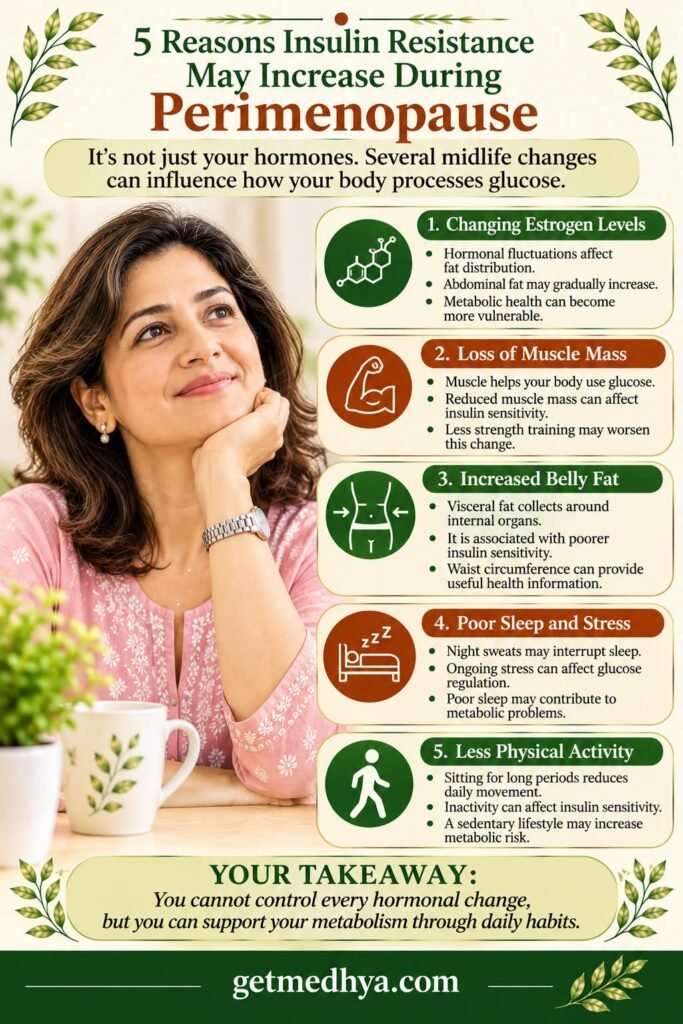
Insulin resistance can happen at any age and for many reasons. What makes this decade different is the number of changes that converge at once. Here are the six main drivers.
Cause 1: Estrogen was quietly protecting your insulin sensitivity
Estrogen is not only a reproductive hormone. It interacts with insulin signalling in muscle, liver, fat tissue and the brain. In the reproductive years, healthy estrogen levels help your cells respond to insulin, influence where your body stores fat (more around hips and thighs than the abdomen), and help regulate appetite through the hypothalamus.
In perimenopause, estrogen does not simply decline in a neat line. It fluctuates, sometimes swinging higher than normal and sometimes dropping sharply, before the longer-term decline of menopause. Large studies following women through the menopausal transition have found that body fat distribution shifts toward the abdomen and that visceral fat (the deep fat around your organs) increases during this window, independent of chronological age.
As that estrogen protection becomes less reliable, your cells’ response to insulin can weaken. The same meal that produced a gentle glucose rise in your thirties may now produce a bigger glucose and insulin response.
Cause 2: Falling progesterone and disrupted sleep
Progesterone is often the first hormone to decline in perimenopause, sometimes years before estrogen changes dramatically. Progesterone has a calming, sleep-supporting effect. When it dips, many women notice lighter sleep, more night waking, and early-morning wake-ups.
This matters for insulin because sleep is one of the strongest regulators of insulin sensitivity. Research on sleep restriction has shown that even a few nights of short or fragmented sleep can measurably reduce insulin sensitivity in otherwise healthy people. Poor sleep also raises hunger and appetite signals and increases the desire for energy-dense, sugary, and starchy foods.
The result is a loop: hormonal changes disrupt sleep, poor sleep worsens insulin resistance, and insulin resistance and the blood sugar dips it causes can disrupt sleep further.
Cause 3: Cortisol and a stress response that stays switched on
Cortisol, your main stress hormone, has a direct job in blood sugar regulation: it signals the liver to release glucose, so you have fuel to deal with a threat. In short bursts, this is useful. When cortisol stays elevated because of chronic stress, poor sleep, under-eating, over-exercising, or constant mental load, your liver keeps releasing glucose and your cells keep being asked to respond to insulin.
Chronically high cortisol is also associated with fat storage around the abdomen. Visceral fat has more cortisol receptors than fat elsewhere, which is one reason stress and belly weight so often travel together.
Perimenopause tends to coincide with peak life demands: careers, caregiving for children and ageing parents, and your own symptoms disturbing your rest. A stress-sensitive nervous system plus shifting hormones is a powerful recipe for higher cortisol and less insulin sensitivity.
Cause 4: Muscle loss and a smaller glucose “sink”
Skeletal muscle is the largest site of glucose disposal after a meal. Healthy, active muscle is like a large, absorbent sponge for blood glucose. When muscle mass and quality decline, there is less tissue available to take up glucose, and what remains may be less responsive.
From midlife onward, women gradually lose muscle mass unless they actively counter it, and the loss tends to accelerate around the menopause transition as estrogen’s supportive effect on muscle declines. If you are also less active than you used to be, or if you rely mostly on cardio or very light activity, your muscle “sink” shrinks further. Smaller sink, higher glucose, higher insulin.
This is also why the number on the scale can mislead. Two women can weigh the same, but the one with more muscle and less visceral fat is far more insulin sensitive.
Cause 5: Belly fat becomes a driver, not just a result
Visceral fat is metabolically active tissue. It releases inflammatory molecules and free fatty acids that make the liver and muscles less responsive to insulin. So the abdominal weight that appears partly because of insulin resistance then makes insulin resistance worse.
This is a feedback loop, and it explains why the problem can feel like it accelerates. The first few centimetres around the waist change how your body handles glucose, which makes the next few more likely.
The good news, which is easy to miss, is that visceral fat responds relatively well to the right changes. It is often one of the first fat stores to shrink when sleep, stress, muscle, and eating patterns improve, sometimes before the scale moves much.
Cause 6: Appetite signals and the craving brain
Estrogen helps regulate appetite and the feeling of fullness. As it fluctuates and declines, many women notice that they feel hungrier, feel full less reliably, and find sweet or starchy foods harder to resist. Add the effect of poor sleep on hunger hormones (ghrelin rises, leptin falls) and the effect of blood sugar dips on the brain’s urgent demand for quick fuel, and cravings stop being a character flaw and become a physiological signal.
Dopamine and serotonin, the brain chemicals linked with reward and mood, are also influenced by estrogen. When mood dips or stress rises, the brain looks for the fastest comfort. Carbohydrates and sugar deliver it. This is why cravings often feel strongest in the late afternoon, in the evening, or in the days before a period.

Part 3: How Insulin Resistance in Perimenopause Creates Cravings, Energy Crashes and Belly Weight
Understanding the mechanism makes each symptom make sense.
The craving cycle
A typical pattern looks like this. You eat a meal that is mostly refined carbohydrate, such as toast, cereal, poha with little protein, a sandwich or pasta, or you skip a meal and then eat quickly. Glucose rises fast. Your pancreas releases a large dose of insulin. Glucose is pulled out of the blood quickly, sometimes below where your brain would like it. Your brain senses a fuel dip and sends urgent signals: hunger, irritability, a strong pull toward something sweet. You eat something sugary, and the cycle repeats.
With insulin resistance, the loop is more intense because insulin levels are higher, the swings are larger, and your brain is less well fuelled between meals. That is why cravings in perimenopause can feel different from the occasional sweet tooth you had before: more urgent, more specific and harder to satisfy with a “healthy” snack.
The energy rollercoaster
Insulin resistance makes it harder for your cells to efficiently take in and use glucose. Even when plenty of glucose is circulating, your cells can be relatively underfuelled. Combine that with post-meal dips, disrupted sleep, and cortisol surges, and energy becomes unpredictable. Typical signs include:
- Feeling sleepy or heavy after meals
- A hard energy wall in mid-afternoon
- A “second wind” late at night, followed by poor sleep
- Waking tired, with morning grogginess that improves after you eat
- Needing caffeine to function, then feeling jittery or anxious
The belly weight pattern
High insulin tells the body to store, and it tells the body not to release stored fat. High cortisol directs storage toward the abdomen. Falling estrogen shifts the default storage pattern from hips and thighs to the middle. Muscle loss lowers your resting energy use. Together, these explain why many women gain around the waist without eating more, and why standard advice to “just eat less and move more” often fails.
It also explains a frustrating pattern: aggressive dieting can make things worse. Severe calorie restriction raises cortisol, can accelerate muscle loss and often triggers rebound cravings, all of which push in the wrong direction for insulin sensitivity.
Part 4: Signs of Insulin Resistance in Perimenopause, and How to Check
Self-check: how many of these sound like you?
Many women recognise several of these. Having a few does not mean you have a diagnosis, but it is a useful signal to investigate.
- Strong cravings for sugar, bread, rice or sweets, especially in the afternoon or evening
- Feeling shaky, irritable or “hangry” if a meal is delayed
- Sleepiness or brain fog after meals
- Weight gain concentrated around the abdomen, with a growing waist
- Difficulty losing weight despite consistent effort
- Waking between 2 and 4am, sometimes with a racing heart or sudden alertness
- Skin tags, or darkened, velvety patches of skin on the neck or underarms (acanthosis nigricans)
- Increased facial or body hair, or irregular cycles, which may indicate overlapping hormonal factors
- A family history of type 2 diabetes, gestational diabetes, or PCOS
- Frequent snacking being necessary to feel okay
Tests worth asking about
A standard check often includes only fasting glucose, and that can look normal for years while insulin is already elevated. Consider discussing the following with your doctor:
- Fasting insulin along with fasting glucose, to calculate HOMA-IR, a commonly used estimate of insulin resistance. Many clinicians consider values above roughly 2 to 2.5 worth attention, though cut-offs vary by lab and population.
- HbA1c, which reflects average blood glucose over about three months. In general, 5.7 to 6.4 percent falls in the prediabetes range.
- Fasting glucose, where values from 100 to 125 mg/dL are generally classified as impaired.
- A lipid panel, particularly triglycerides and HDL cholesterol. A high triglyceride-to-HDL ratio is often a clue to insulin resistance.
- Waist circumference. For many women, a waist above about 88 cm (35 inches) signals higher metabolic risk, and for South Asian women, thresholds are often lower, around 80 cm (31.5 inches).
- An oral glucose tolerance test, sometimes with insulin measured at intervals, can reveal problems that fasting tests miss.
- Thyroid function and ferritin, since these can overlap with fatigue and weight changes.
Always interpret results with your doctor. Lab reference ranges differ, and one number alone rarely tells the whole story.
Tracking at home
Even without a lab test, a few weeks of tracking can be very revealing: note when cravings hit, what you ate beforehand, how you slept, where you are in your cycle, and how you feel two to three hours after meals. Patterns usually emerge quickly. This is exactly the kind of pattern-spotting a daily check-in in a health app can make easier.
Part 5: What Most Women Try, and Why It Backfires With Insulin Resistance in Perimenopause
Cutting calories hard. Severe restriction raises cortisol, speeds muscle loss and sets up intense rebound cravings. It can lower the metabolic rate and worsen the very insulin resistance you are trying to fix.
Going very low carb or cutting out all carbohydrates. Some women do feel better temporarily, but extreme restriction can leave you underfuelled, disrupt sleep and raise cortisol. The goal is not zero carbohydrate. It is steady, well-paired carbohydrate in portions your body can handle.
Skipping breakfast or fasting aggressively. Long fasting windows work for some people but can backfire in perimenopause when cortisol is already high and sleep is fragile. Many women find that very long fasts increase evening cravings and nighttime waking. A gentle overnight gap of around 12 hours is often more than enough.
Doing more and more cardio. Hours of intense cardio on an already-stressed system can raise cortisol and appetite while doing little to build the muscle your insulin sensitivity depends on.
Eating “healthy” carbohydrates on their own. A banana, a fruit juice, a bowl of oats, upma, or a granola bar eaten alone can still cause a significant glucose spike when there is little protein, fat, or fibre alongside it.
Relying on caffeine and sugar to push through the afternoon slump. This provides a short lift and a bigger crash, and it adds to the cortisol-and-glucose roller coaster.
Treating cravings as a willpower failure. Cravings are information. Fighting them with sheer discipline usually fails because the underlying drivers (blood sugar swings, poor sleep, stress, hormonal shifts) are still active.
Waiting until menopause “settles.” Insulin resistance can progress quietly toward prediabetes and type 2 diabetes. The levers available now, including food structure, muscle, sleep, and stress, work regardless of where estrogen is.
Part 6: The Ayurvedic View of Insulin Resistance in Perimenopause
Ayurveda never used the words “insulin” or “glycaemic index,” but it described a very similar pattern of metabolic heaviness, sluggish digestion, excess sweetness in the body and abdominal accumulation, and it linked them to lifestyle, digestion and stress.
Agni and Ama
In Ayurveda, Agni is your digestive and metabolic fire. When Agni is weak or irregular, food is not fully transformed, and the residue, known as Ama, accumulates. Ama is associated with heaviness, fatigue, sluggishness, and a dull mind. Modern language might describe something similar: reduced metabolic efficiency, inflammation, and a body that is not using fuel well.
Kapha, Meda and the tendency to store
Ayurveda associates the accumulation of excess tissue, especially fat tissue (Meda dhatu), with an imbalance of Kapha, the principle of structure, moisture and stability. Classical descriptions of metabolic disorders involving excess sweetness (the Prameha group of conditions) emphasise heavy, sweet, oily and sedentary patterns, along with poor digestion. Perimenopause is traditionally seen as a time when Vata begins to rise, bringing irregularity, anxiety and disturbed sleep, while Kapha and Pitta imbalances can express as weight, inflammation and heat. Vata instability drives erratic eating and poor sleep, which in turn weakens Agni, which in turn encourages Kapha accumulation.
Pitta, the liver and the stress connection
Ayurveda holds that Ranjaka Pitta, associated with the liver, is central to metabolic transformation, and that emotional strain and chronic stress aggravate Pitta and unsettle digestion. This parallels the modern understanding that stress hormones and liver glucose output are tightly linked.
What this means practically
The Ayurvedic approach is not to starve or punish the body. It is to rekindle Agni, reduce Ama, regulate daily rhythms and gently balance Kapha. In practice that means regular meal timing, warm, freshly cooked food, bitter and astringent tastes, spices such as cumin, coriander, fennel, ginger, turmeric and cinnamon, regular movement and a calm evening routine. Traditional foods such as methi (fenugreek) seeds, karela (bitter gourd), jamun, amla and legumes have long been used in metabolic support, and some have modest research behind them. Treat them as part of a food pattern, not as a replacement for medical care.
Part 7: A Step-by-Step Plan to Improve Insulin Resistance in Perimenopause
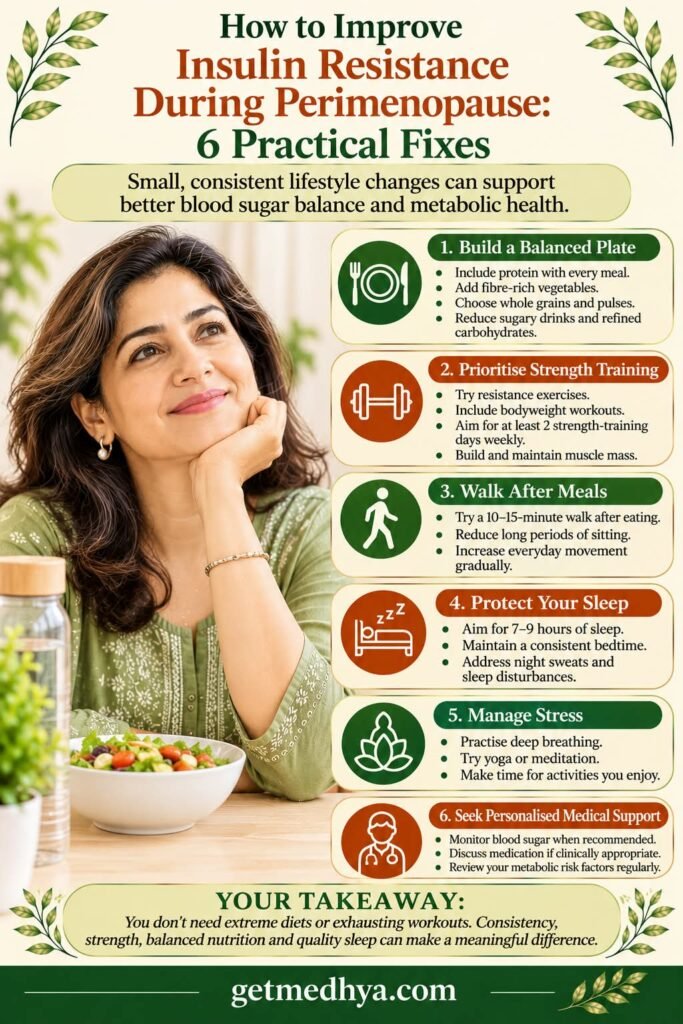
The aim is not perfection. It is to reduce the glucose and insulin swings, rebuild muscle, calm cortisol and protect sleep. Work through these in order, adding one layer at a time.
Step 1: Rebuild the structure of every meal
This is the single most powerful daily lever.
Anchor each meal with protein. Many women in this stage do well aiming for roughly 25 to 30 grams of protein per meal, though your individual needs depend on your size, activity and health, so adjust with your doctor or dietitian if needed. Good options include eggs, paneer, Greek yogurt or curd, dal, chana, rajma, tofu, tempeh, fish, chicken and nuts.
Add fibre and healthy fat. Vegetables, salad, legumes, seeds (flax, chia, pumpkin), nuts, olive oil, ghee in moderate amounts, and avocado all slow glucose absorption and increase fullness.
Change the order you eat. Several studies suggest that eating vegetables and protein before the carbohydrate portion of a meal can reduce the post-meal glucose rise. Try starting lunch with salad or sabzi and dal, then moving to roti or rice.
Choose slower carbohydrates, and keep them. Millets (ragi, jowar, bajra), oats, quinoa, brown or parboiled rice, sweet potato, legumes and whole fruit tend to produce gentler rises than refined flour, white bread, sugary cereals and juices. You do not need to remove carbohydrate. You need to pair and portion it.
Eat a real breakfast. Within an hour or two of waking, aim for a protein-led breakfast, such as eggs with vegetables, besan chilla with curd, moong dal cheela, a paneer wrap, or Greek yogurt with nuts and seeds. A protein-rich start steadies glucose for much of the day.
Example of the difference: A bowl of plain poha and a cup of sweet chai versus a vegetable moong cheela with curd and a handful of nuts. The calories may be similar. The glucose and craving response often is not.
Step 2: Build muscle, because it is your glucose sink
Strength train two to three times a week. This can be gym weights, resistance bands, bodyweight work or a structured home programme. Focus on large muscle groups: squats, lunges, hip hinges, rows, presses and carries. Progressive overload, meaning gradually increasing the challenge, matters more than long sessions. Thirty to forty-five minutes is enough.
Walk after meals. A gentle 10 to 15 minute walk after eating is one of the most evidence-supported ways to lower post-meal glucose, because working muscles pull glucose from the blood without needing as much insulin.
Break up sitting. Standing or moving for a couple of minutes every 30 to 60 minutes of desk work improves glucose handling more than most people expect.
Be careful with excessive high-intensity exercise. A couple of short, higher-intensity sessions can help, but piling them on top of poor sleep and high stress may backfire. Let recovery be part of the plan.
Step 3: Protect your sleep as a metabolic treatment
Keep a consistent sleep and wake time. Regularity helps your circadian rhythm, which in turn regulates glucose and cortisol.
Eat dinner earlier and keep it balanced. A dinner two to three hours before bed, with protein, fibre and a moderate carbohydrate portion, supports steadier overnight glucose. Eating nothing at all in the evening can lead to night-time blood sugar dips and waking in some women.
Build a wind-down routine. Dim lights, reduce screens, and consider slow breathing, gentle stretching or a short meditation. Extending your exhale (for example, inhale for four, exhale for six to eight) activates the parasympathetic system and lowers stress arousal.
Limit alcohol. Alcohol fragments sleep, can trigger early-morning waking and hot flushes, and adds to glucose dysregulation. Many women find they tolerate it much less in perimenopause.
Mind caffeine timing. Aim to have your last caffeinated drink before early afternoon, and have it after food rather than on an empty stomach.
Step 4: Lower the cortisol load
Schedule a daily stress-down practice. Even ten minutes of breathwork, meditation, yoga nidra or quiet time outdoors, done consistently, can reduce physiological stress arousal. The key is regularity, not intensity.
Notice your stress-eating triggers. If cravings spike after meetings, arguments or doomscrolling, that is cortisol at work. Have a plan: a protein snack, a short walk, a few minutes of breathing.
Get morning light. Ten to fifteen minutes of natural light after waking anchors your body clock and supports cortisol rhythm.
Create genuine recovery time. Back-to-back demands without recovery keep the stress response active even if you are sleeping and eating reasonably well.
Step 5: Manage cravings practically
Never meet a craving on an empty, underfed system. If a craving hits mid-afternoon, check whether lunch had enough protein and fibre. If not, a protein-based snack (a boiled egg, roasted chana, curd with seeds, a handful of almonds) may settle it better than sweet food.
Plan your sweet, don’t ban it. Having something sweet after a balanced meal, rather than alone on an empty stomach, produces a smaller glucose spike. A square of dark chocolate, a piece of fruit with nuts or a small portion of a traditional sweet after lunch can fit.
Use the 15-minute pause. When a craving arrives, drink a glass of water, take a short walk or do five slow breaths. If it is still there afterwards, eat it mindfully without guilt. Guilt feeds the stress loop.
Watch cycle timing. If you still have periods, notice whether cravings are strongest in the week before bleeding. Insulin sensitivity tends to be slightly lower in the luteal phase, so extra protein, fibre and magnesium-rich foods (leafy greens, pumpkin seeds, almonds, legumes) can help.
Step 6: Support your gut and liver
A healthy gut microbiome influences inflammation and glucose regulation, and the liver plays a central role in glucose output and fat metabolism.
- Include a variety of fibre sources: vegetables, legumes, whole grains, fruits, seeds.
- Add fermented foods such as curd, buttermilk, kanji or fermented vegetables if you tolerate them.
- Include cruciferous vegetables (broccoli, cabbage, cauliflower) and bitter greens.
- Limit ultra-processed foods, sugary drinks and frequently fried foods, which tend to worsen liver fat and inflammation.
Step 7: Consider medical and supplement support, with your doctor
Some women benefit from additional support, and this is a conversation for a qualified healthcare professional.
- Menopausal hormone therapy may influence insulin sensitivity and body fat distribution in some women, and decisions about it depend on your individual health, age, timing and risk profile.
- Medications such as metformin may be appropriate if you have prediabetes or diabetes. Never start or stop these without medical advice.
- Supplements such as magnesium, omega-3 fatty acids, myo-inositol or berberine are sometimes discussed for metabolic support, with varying levels of evidence. Quality, dosage and interactions matter, so check with your doctor before adding any.
- Check your levels of vitamin D, B12 and iron, which commonly affect energy and may overlap with your symptoms.
Step 8: Track, adjust and be patient
Because the picture is shaped by several systems, tracking is more useful than guessing. Watch your energy two to three hours after meals, your cravings, your sleep and your waist measurement, not just your weight. Recheck labs with your doctor after a few months of consistent changes.
Part 8: Troubleshooting Insulin Resistance in Perimenopause
“I’m eating well, and my cravings are still intense.” Check sleep first. Short or fragmented sleep can drive cravings regardless of food quality. Then check whether meals contain enough protein, and whether long gaps between meals are leaving you under-fuelled.
“I’m exercising a lot, and my belly isn’t shrinking.” Look at the type and recovery. If it is mostly cardio, add strength training. If you are training hard on little sleep and high stress, reduce intensity and prioritise recovery. Also remember that waist measurement may improve before the scale does.
“I feel worse when I cut carbohydrates.” You may be cutting too much, or doing it too suddenly. Reintroduce slower carbohydrates in sensible portions alongside protein and fibre, and notice how your energy and sleep respond.
“I wake at 3am wide awake.” This can reflect a blood sugar dip with a cortisol response. Review your dinner composition and timing, and consider a small protein-and-fat snack before bed if you are not eating enough in the evening. Persistent waking deserves discussion with your doctor.
“My results are normal but I still have symptoms.” Standard tests can miss early insulin resistance. Ask about fasting insulin, HOMA-IR, triglyceride to HDL ratio and an oral glucose tolerance test. Also rule out thyroid issues, iron deficiency and vitamin deficiencies.
“Some weeks are fine and others are awful.” Hormonal fluctuation in perimenopause is unpredictable. Track against your cycle and stress load over two to three months, and expect that flares can occur even when you are doing most things right.
Part 9: The Plan Week by Week
Weeks 1 to 2: Stabilise your meals. Focus on protein-anchored meals, a real breakfast and starting meals with vegetables and protein. Add a short walk after your largest meal. What you may notice: fewer sharp afternoon crashes, less intense cravings, and steadier energy in the first half of the day.
Weeks 3 to 4: Add movement and protect the evening. Begin two strength sessions a week, tidy up your dinner timing and composition, and set a consistent sleep window. What you may notice: easier mornings, fewer night wake-ups and less post-meal sleepiness.
Weeks 5 to 8: Lower the stress load. Make a daily breathing or meditation practice non-negotiable, adjust caffeine and alcohol, and increase strength training to three sessions if recovery allows. What you may notice: cravings feeling more manageable, better resilience in stressful weeks, and early changes in how your waistband fits.
Weeks 9 to 12: Review and refine. Re-measure your waist, review your tracking, and discuss repeat labs and any further support with your doctor. What you may notice: a clearer, steadier baseline of energy, fewer and less severe flare days, and often a smaller waist even when weight changes are modest.
What Real Progress Looks Like
Progress rarely arrives as one dramatic turning point. It tends to look like a quieter shift: the afternoon craving that used to feel unbearable becomes something you can notice and meet calmly. A meal no longer leaves you needing a nap. You realise a week has passed without the 3pm wall. Your jeans close a little more easily around the waist, even though the scale has barely moved.
Early changes in cravings and energy often show up within one to two weeks of consistently structuring meals and walking after eating. Deeper changes in sleep, cortisol patterns and body composition usually take eight to twelve weeks or longer. Hormonal fluctuation will still bring harder days. That is the nature of this decade, not a sign that the approach has failed.
Frequently Asked Questions About Insulin Resistance in Perimenopause
Can insulin resistance in perimenopause be reversed?
In many cases, insulin sensitivity can be significantly improved through food structure, strength training, sleep, stress management and, where appropriate, medical support. Outcomes vary by individual, and it is best to work with your healthcare provider, particularly if you have prediabetes or diabetes.
Why am I gaining belly fat in perimenopause when I haven’t changed my diet?
Changing estrogen shifts fat storage toward the abdomen, muscle mass tends to decline, cortisol and insulin often rise, and sleep may worsen. Together, these can change your body composition even if your eating habits stay the same.
Do cravings in perimenopause mean I have insulin resistance?
Not necessarily. Cravings can have many causes, including sleep loss, stress, skipped meals and hormonal shifts. But frequent, intense carbohydrate cravings alongside fatigue and abdominal weight gain are a good reason to ask about testing.
Should I avoid carbohydrates completely?
For most women, no. Choosing slower-digesting carbohydrates, pairing them with protein, fibre and healthy fat, and managing portions is usually more sustainable and gentler on sleep and stress hormones than eliminating them.
What is the best exercise for insulin resistance in perimenopause?
A combination works best: regular strength training to build muscle, daily walking including short post-meal walks, and enough recovery. Consistency matters more than intensity.
How do I know if my fasting glucose is normal but insulin is still high?
This requires a fasting insulin test (often used to calculate HOMA-IR) or an oral glucose tolerance test with insulin measurements. Ask your doctor whether these are appropriate for you.
Where to Go From Here
Cravings, crashes and a thickening waist are not signs that you are failing at discipline. They are signs that your metabolism is responding to real shifts in estrogen, progesterone, sleep, stress and muscle, and every one of those has levers you can pull. When you stabilise your meals, build muscle, protect your sleep and calm your stress response, insulin sensitivity can improve, and the cravings, the energy and the belly weight tend to follow.
If you want guidance built around your own patterns, the Medhya app gives you personalised meal plans, daily tracking, workouts, breathwork and meditations to support steadier blood sugar, better sleep and calmer energy, and you can start by getting your Medhya Health Score to see which systems need the most support right now.
This article is for educational purposes only and reflects general wellness information drawn from published research. It is not a substitute for personalised medical advice, diagnosis or treatment. If you suspect insulin resistance, prediabetes or diabetes, or you have symptoms such as excessive thirst, frequent urination, unexplained weight loss or blurred vision, please speak with your healthcare provider for testing and guidance.

