Can Perimenopause Start at 35? 12 Early Signs & What Helps

You’re 35. Maybe your period arrived four days early for the third month running. Maybe you’re waking at 3am with a racing heart, snapping at people you love, or losing words mid-sentence in meetings. You typed the question into your phone, half hoping for a reassuring no: can perimenopause start at 35?
The honest answer is yes, it can, but it’s uncommon, and it deserves a proper look rather than a shrug. Most women meet the first changes of perimenopause in their early-to-mid 40s. A small group notices them in their late 30s, and a smaller group earlier still. If you’re one of them, you’ve probably already heard some version of “you’re too young for that” or “it’s just stress,” and left feeling that you’re either imagining it or that something is wrong that nobody can find.
Neither is true. What’s often happening at 35 is a real shift in how your hormones, blood sugar, stress response and sleep are working together, and that shift has a cause worth understanding. Sometimes it is early perimenopause. Sometimes it is thyroid, iron, PCOS, burnout, or a mix of several things. The skill is knowing how to tell them apart.
This guide walks you through exactly that. You’ll learn what perimenopause at 35 actually means, why it can start this early, the 12 early perimenopause signs to look for, the conditions that mimic it, which tests are worth asking for, and what you can do from today to support your body. No panic, no vague “it varies.” A clear framework you can act on.
Part 1: Can Perimenopause Start at 35? The Honest Answer
Let’s start with the numbers, because they matter and they’re often misquoted.
The average age of natural menopause, the point when you’ve gone 12 months without a period, is around 51 in Western countries. Several studies in Indian women place it earlier, often in the mid-to-late 40s. Perimenopause is the transition before that final period, and it usually lasts several years, commonly four to eight, though it can be shorter or longer. Clear signs most often begin somewhere between 42 and 47.
So is perimenopause at 35 possible? Yes. Is it typical? No. Clinicians generally describe three different situations when symptoms appear in the 30s and early 40s:
Early perimenopause. The transition begins a few years ahead of average, in the late 30s or early 40s. This is a variation of normal ageing of the ovaries, and it is more common than most women are told.
Early menopause. Periods stop permanently between 40 and 45. This affects roughly 5% of women, or about 1 in 20.
Premature ovarian insufficiency (POI). The ovaries stop working normally before 40. This affects roughly 1% of women, about 1 in 100. Periods may become irregular or stop, and in POI ovarian function can sometimes come and go, so pregnancy is occasionally still possible.
This distinction matters. Perimenopause in your late 30s is usually a gradual, manageable shift. POI is a medical condition that benefits from proper evaluation, because the long-term health of your bones, heart and brain depends partly on how long you’re exposed to estrogen. That’s why, below 40, we don’t guess. We look.
Why 35 feels like a surprise
Fertility starts to decline gradually from the early-to-mid 30s, and many women assume that’s the same thing as perimenopause. It isn’t. A decline in egg quantity and quality is a slow, quiet process. Perimenopause is when the hormonal rhythm itself, the monthly dance between estrogen and progesterone, begins to lose its consistency. You can have the first without noticing the second for years.
And here is the part almost nobody explains: the earliest hormonal change is usually not falling estrogen. It’s falling progesterone, the calming, sleep-supporting hormone, as ovulation becomes less reliable. That can happen while your cycle still looks perfectly regular. It’s why a 35-year-old can feel anxious, wired, sleepless and premenstrually miserable for a year or two before a single period changes.
The 35-year-old’s reality check
If you’re 35 and noticing changes, the most likely explanation is not early perimenopause. The statistically likely culprits are stress load, sleep debt, thyroid changes, low iron, blood sugar instability, PCOS, or a recent change in birth control. But “less likely” is not “impossible,” and it’s a mistake to be dismissed on age alone, especially if you have a family history, certain medical conditions, or symptoms that cluster together. The practical message: track, test the right things, and treat the root cause rather than the label.
Part 2: Why Perimenopause at 35 Can Start This Early: The Root Causes
Women are often told early onset is “just genetics.” Genetics play a real role, but they’re rarely the whole story. Understanding the contributing factors gives you something to work with.
Your ovarian reserve and the timing you were born with
You’re born with a finite number of eggs, and the pace at which they’re used up varies from person to person. Some women simply have a smaller starting reserve or a faster rate of loss. This is the part you can’t change, and it’s one reason timing can differ so much between friends who are the same age.
Family history
If your mother or sisters reached menopause or perimenopause early, you’re statistically more likely to follow a similar timeline. Ask them, if you can. Many women have never had this conversation, and the answer is one of the most useful pieces of information you can bring to a doctor.
Smoking and heavy alcohol use
Smoking is consistently associated with earlier menopause, sometimes by one to two years. Tobacco chemicals appear to be toxic to ovarian follicles. Heavy alcohol use also disrupts hormone metabolism and liver clearance of estrogen, which can make symptoms feel more intense.
Autoimmune and thyroid conditions
Autoimmune conditions, especially autoimmune thyroid disease, are associated with a higher chance of reduced ovarian function. This is one reason a good evaluation always looks at the thyroid.
Medical treatments and surgery
Chemotherapy, pelvic radiation and some ovarian surgeries, including surgery for endometriosis or large cysts, can reduce ovarian reserve. A hysterectomy that leaves the ovaries in place doesn’t cause menopause, but it can bring ovarian ageing forward in some women and removes the period as a signal.
Blood sugar, insulin and metabolic health
Insulin resistance, PCOS and chronic blood sugar swings don’t cause early menopause. But they interact with the hormonal shifts in powerful ways. Unstable blood sugar triggers cortisol surges, worsens sleep, drives cravings and fatigue, and makes the symptoms of early perimenopause louder. In India, where insulin resistance and PCOS affect a significant number of women in their 20s and 30s, this overlap is especially important to understand.
Chronic stress and the cortisol-progesterone competition
There is no solid evidence that stress alone makes your ovaries age faster. What stress does is far more practical: it disrupts ovulation in some women, deepens the progesterone dip, fragments sleep, and amplifies anxiety, brain fog and irritability. Cortisol and progesterone draw on a shared hormonal pathway, so a body under constant pressure has less room for calm. At 35, with career, caregiving, young children or ageing parents all at once, that pressure is often at its peak.
Nutritional depletion and restrictive dieting
Very low body weight, years of crash dieting, undereating and nutrient deficiencies can disrupt the signals between the brain and the ovaries, producing irregular or missed periods that look like early perimenopause but have a different cause, and often a different solution.
The compounding effect
Most women at 35 have more than one of these in play. A slightly smaller ovarian reserve, plus a stressful job, plus low iron from heavy periods, plus poor sleep, can add up to a body that feels like it’s in perimenopause, whether or not the clinical definition is met. That’s why looking at the whole picture matters more than chasing a single label.
Part 3: 12 Early Perimenopause Signs at 35
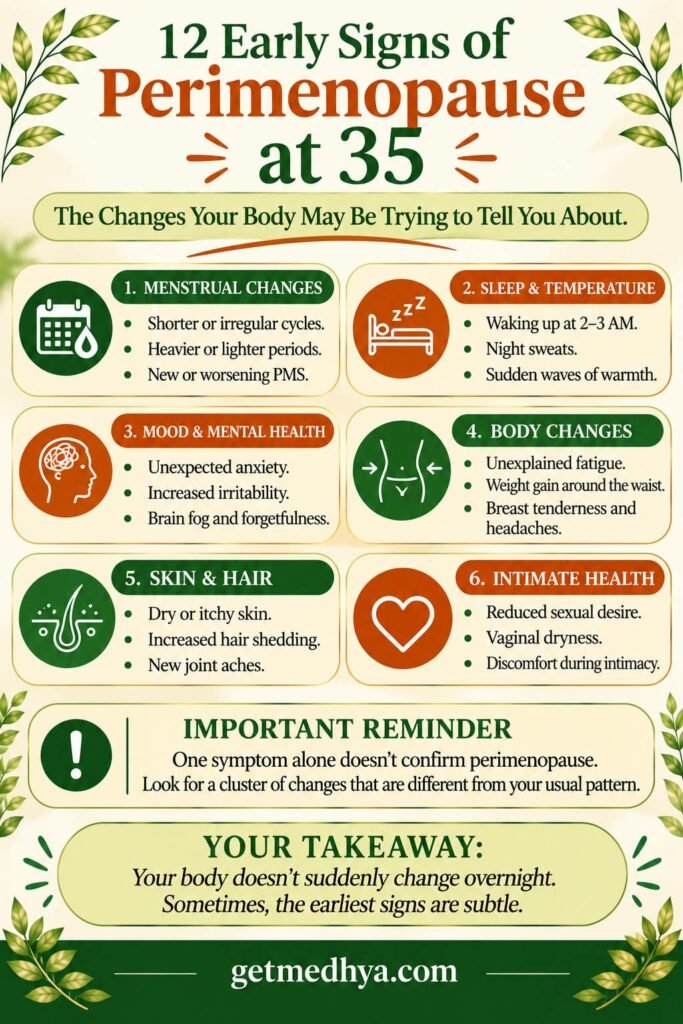
Hot flashes get all the attention, but they are often a later arrival. The earliest signs are quieter, and they tend to appear in clusters across several body systems. Here are the 12 early perimenopause signs worth watching for.
1. Your cycle length changes
This is the most objective signal. Cycles that become shorter (say, 28 days becoming 24), or that vary by seven days or more from one month to the next, are classic early markers. A single odd month means little. A sustained shift from your own baseline means more.
2. Your flow changes
Heavier flow with clots, unexpectedly light periods, or spotting between periods that wasn’t part of your pattern before. Heavier bleeding in particular can quietly drain iron, which then causes its own symptoms.
3. PMS that is new or suddenly worse
Tearfulness, rage, breast tenderness, bloating and headaches in the week before your period, especially if you never had PMS before, or if it got significantly worse in the last year or two. This is often the very first sign, driven by lower progesterone relative to estrogen.
4. Sleep that no longer holds
Falling asleep fine, then waking at 2 or 3am wide awake. Or trouble falling asleep despite being exhausted. Progesterone has a calming effect on the brain, so when it drops, sleep is often the first thing to suffer.
5. Night sweats or sudden warmth
Waking damp, or feeling a wave of heat in the evening. At 35 these are less common, but new heat symptoms before 40 are worth taking seriously and mentioning to your doctor.
6. Anxiety, irritability and low mood
A shorter fuse, a low hum of dread, a racing heart that arrives for no reason, or a flatness that doesn’t match your life. Estrogen and progesterone both influence serotonin, GABA and other calming chemicals in the brain. When they swing, mood often swings with them.
7. Brain fog
Words vanishing mid-sentence, walking into a room and forgetting why, rereading the same paragraph. Estrogen supports how brain cells use glucose for fuel, so when it fluctuates, thinking can feel like it takes more effort. This is different from dementia and tends to fluctuate with sleep, stress and blood sugar.
8. Fatigue that rest doesn’t fix
A tiredness that lingers even after a full night’s sleep, often with an afternoon crash. This can be hormonal, but it is also the classic sign of low iron or thyroid trouble, so it deserves to be investigated rather than assumed.
9. Breast tenderness and headaches
New breast soreness, or headaches and migraines that cluster around your period or have become more frequent. These often track the rise and fall of estrogen across the cycle.
10. Weight around the middle, cravings and bloating
Weight that gathers around the waist even though your habits haven’t changed, stronger sugar cravings, and a bloated or sluggish gut. Hormonal shifts affect insulin sensitivity, appetite signals and how your body handles stress, and digestion often feels it first.
11. Skin, hair and joint changes
Drier or itchier skin, more shedding in the shower, new aches in the knees, hips or fingers. Estrogen supports collagen, skin moisture and joint tissue. Hair shedding in particular can also point to low ferritin or thyroid issues, so check these before assuming it’s hormonal.
12. Shifts in libido and vaginal comfort
A lower desire than before, dryness, or discomfort during sex. These are often dismissed as stress, but they can reflect hormonal change and are worth bringing up, because they’re very treatable.
Why the cluster matters more than any single sign
Any one of these signs can have an ordinary explanation. A bad month at work can cause poor sleep and irritability. What points toward early perimenopause is a cluster: several signs, across mood, sleep, cycle and body, arriving in the same window and representing a genuine shift from how you used to feel.
Quick self-check: does your pattern fit early perimenopause at 35?
Count the statements that are true for you over the last six months.
Cycle: my cycle length varies by 7 or more days; my flow has changed noticeably; I get spotting between periods; I skipped a period without being pregnant.
Mood and nervous system: I have new anxiety or irritability; small stressors hit harder; I feel unlike myself.
Sleep and temperature: I wake at night for no reason; I have night sweats or sudden heat; I wake tired.
Body and brain: I have new brain fog; my PMS is worse; my breasts, joints or skin feel different; my weight is shifting around my middle.
How to read it: several ticks in the cycle group plus a handful elsewhere is a classic early pattern worth tracking and discussing with a doctor. Mostly mood and sleep ticks with a normal cycle is common too, and may reflect early progesterone decline, but it also overlaps with several other conditions, covered next. One or two scattered ticks may simply reflect a stressful season.
Part 4: Is It Really Perimenopause at 35? What Else It Could Be
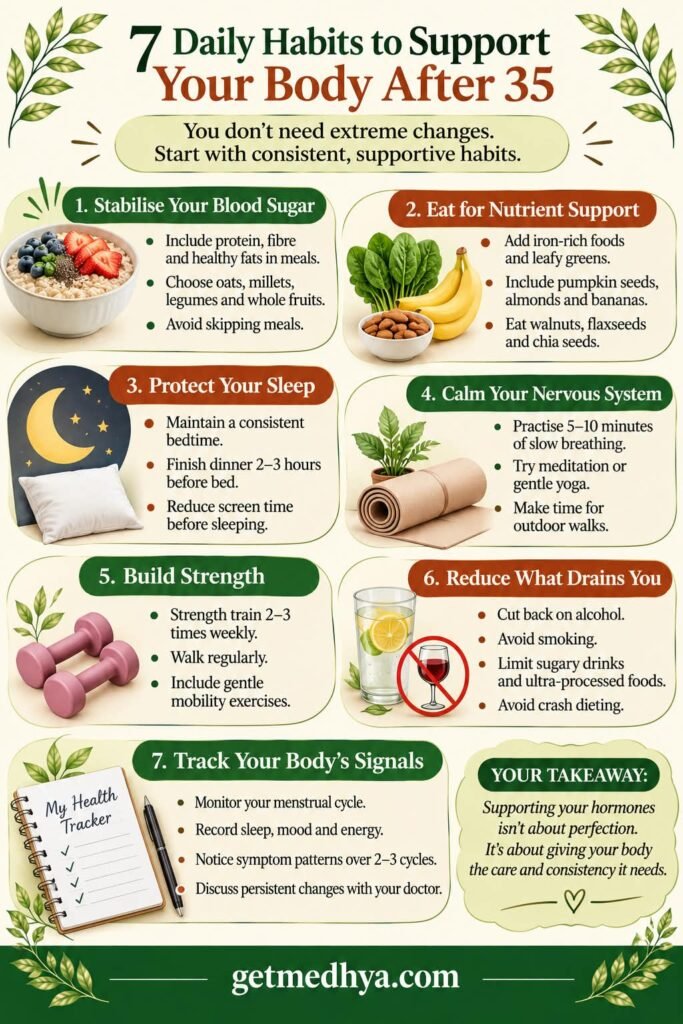
This is the section most articles skip, and it’s arguably the most important. At 35, the symptoms above are far more often caused by something else, or by perimenopause plus something else. Ruling these in or out saves months of frustration.
Thyroid dysfunction
An underactive or overactive thyroid can cause fatigue, anxiety, weight changes, hair shedding, temperature sensitivity, brain fog and irregular periods. Thyroid problems are common in women in their 30s, particularly autoimmune thyroiditis, and are treated very differently from perimenopause.
Low iron and low ferritin
Heavy or frequent periods can quietly empty your iron stores long before a standard blood count shows anaemia. Low ferritin can cause fatigue, brain fog, hair loss, breathlessness and restless legs. In Indian women, iron deficiency is especially common, so this is worth checking directly.
PCOS and chronic cycle irregularity
If your cycles have always been irregular, that points more toward PCOS or another long-standing pattern than toward perimenopause. Perimenopause is a change from your own baseline, not irregularity that has always been your normal.
High prolactin
Elevated prolactin can stop or disrupt periods and is easily checked with a blood test. It’s a common and treatable reason for missed periods in younger women.
Chronic stress, burnout and sleep debt
Sustained stress can on its own disturb cycles, sleep, mood and concentration. It can also make genuine perimenopause symptoms feel far worse, so addressing it helps regardless of the final label.
Pregnancy and postpartum changes
A missed period at 35 should always be checked against pregnancy first. If you’ve had a baby in the last year or two, postpartum hormonal shifts, especially while breastfeeding, can produce a strikingly similar picture.
Contraception and medication changes
Starting or stopping hormonal birth control, and some antidepressants and other medicines, can change your cycle, mood and sleep. Hormonal contraception can also mask the signs of perimenopause, which is worth remembering if you’re on it.
Vitamin B12, vitamin D and sleep apnoea
Low B12 can cause fatigue, fog and low mood. Low vitamin D is extremely common in India and linked to tiredness and aches. Sleep apnoea, which isn’t only a problem for men, can cause unrefreshing sleep, morning headaches and daytime fog.
Why “several things at once” is the most common answer
It’s completely normal for two or three of these to overlap. A woman can have early hormonal changes, mildly low iron and a sluggish thyroid at the same time, each contributing to the same tired, foggy, unlike-herself feeling, each responding to different support. A checklist is the starting point. It tells you what’s worth testing, not what to conclude.
Part 5: Testing for Perimenopause at 35: What to Ask Your Doctor For
Below 40, testing is genuinely more useful than it is in your late 40s, because the goal is to rule out other causes and to check for premature ovarian insufficiency. Walking in with data changes the conversation.
Bring this with you
Two to three months of cycle tracking (start dates, flow, spotting), a written symptom list grouped by mood, sleep, body and brain, your family history of early menopause, and a clear ask: “I’m 35 and my cycle and symptoms have changed. I’d like to rule out thyroid and iron issues and check whether this could be early perimenopause.”
Tests that are worth discussing
FSH and estradiol. If you’re under 40, doctors commonly look for a consistently raised FSH on two tests, usually at least four weeks apart, to assess for POI. In your 30s these levels can still swing from month to month, so one result is not the whole story, and a single normal result does not rule out early perimenopause.
AMH (anti-Müllerian hormone). This gives a rough sense of ovarian reserve. It’s useful context, but it is not a diagnosis and it doesn’t predict exactly when your periods will change.
TSH, with free T3 and T4 if abnormal. To rule out thyroid dysfunction, which overlaps heavily with early perimenopause.
Ferritin, not just haemoglobin. Ferritin drops well before haemoglobin does, so a “normal” blood count can still hide low iron stores.
Prolactin and a pregnancy test. For missed or irregular periods, these are simple and often overlooked first steps.
HbA1c, fasting glucose or fasting insulin. To look at blood sugar and insulin resistance, which shape energy, cravings, sleep and weight.
Vitamin B12 and vitamin D. Both are commonly low and both can mimic or worsen the symptoms above.
When not to wait
See a doctor promptly if you’ve gone three months or more without a period and you’re not pregnant, if you’re having hot flashes or night sweats before 40, if you have a family history of early menopause, if you have very heavy bleeding, or if you’re hoping to conceive. If pregnancy is on your mind, don’t delay: ovarian reserve can change, and a fertility specialist can discuss options with you.
A note on contraception
Perimenopause is not menopause. Ovulation still happens, unpredictably, so pregnancy is still possible. If you’re not trying to conceive, keep using contraception until your doctor advises otherwise.
Why a “normal” result isn’t the end
You may still be told your diagnosis is “clinical,” based on your pattern and history rather than one number. That isn’t your doctor being vague. It reflects how hormones actually behave in this transition. Normal labs with ongoing symptoms means the next step is to keep tracking and investigate further, not to be sent home with “it’s just stress.”
Part 6: Why Early Perimenopause Signs Matter Beyond How You Feel
It’s tempting to treat all this as a comfort issue. For most women with perimenopause at 35 or 38, it’s mainly about quality of life, and it’s very manageable. But when the underlying issue is POI or early menopause, there is a bigger reason to get a proper diagnosis: estrogen helps protect bone density, heart health and brain health. Longer exposure to low estrogen can raise the risk of osteoporosis and cardiovascular disease later.
That is why medical guidance usually recommends that women with confirmed POI discuss hormone therapy with their doctor, often continued until around the average age of natural menopause, along with bone health monitoring. This is a decision for you and your doctor to make together. The point here is simple: if you’re under 40 and your signs are real, getting answers early protects your future self.
Part 7: The Root Cause View: What’s Actually Driving Early Perimenopause Signs
Whether your situation turns out to be classic early perimenopause or a mix of causes, the same body systems are usually involved. Understanding them is what turns “I feel awful” into a plan.

Progesterone first, estrogen swings second
As ovulation becomes less reliable, progesterone dips first, and estrogen starts to swing rather than decline smoothly. At times it runs higher than usual, at other times lower. This hormonal “roller coaster” explains why symptoms can be intense one week and almost vanish the next.
Blood sugar stability
Your brain depends on a steady supply of glucose. As estrogen fluctuates, the brain becomes less efficient at using that fuel, so a blood sugar crash that you shrugged off at 28 now lands harder. Spikes and dips drive the afternoon slump, the 3am wake-up, the sugar cravings and the shaky, irritable feeling before meals.
Cortisol and the nervous system
When blood sugar drops or stress piles up, cortisol rises to rescue you. If this becomes constant, your nervous system stays in a mild state of alarm: light sleep, racing thoughts, tension in the jaw and shoulders, and a body that never quite settles. Cortisol and progesterone share a pathway, so high stress can deepen the progesterone shortfall and amplify the whole picture.
Liver and gut: the estrogen clearance route
Your liver and gut process and clear used hormones. When digestion is sluggish, fibre is low, or the liver is overloaded, estrogen metabolism can become less efficient, which may worsen bloating, breast tenderness, headaches and heavy periods. Gut health, in other words, is not a side issue. It is part of hormone balance.
Sleep as the repair window
Sleep is when the brain consolidates memory, the liver regulates overnight glucose and the stress system resets. When progesterone dips and cortisol runs high, sleep fragments, and everything else gets harder the next day. This is why protecting sleep is often the highest-return step of all.
Inflammation
Poor sleep, unstable blood sugar, chronic stress and low nutrient intake all push the body toward low-grade inflammation, which can show up as joint aches, skin changes, fatigue and low mood. An anti-inflammatory, nutrient-dense way of eating helps calm this from several angles at once.
Part 8: The Ayurvedic View of Early Perimenopause Signs at 35
Ayurveda never needed a blood test to recognise that this stage of life brings change. It describes the body through three doshas, and the transition years are associated with a rise in Vata, the principle of movement, dryness and irregularity.
Vata and the early signs. Irregular cycles, light or fragmented sleep, anxiety, dryness, bloating and a mind that won’t settle all read as classic Vata imbalance. In this view, the signs often show up before any clinical marker changes, which matches what so many women at 35 describe: something has shifted, long before anything is measurable.
Pitta and the heat signs. Irritability, night sweats, heat, skin flare-ups and sharp hunger point to aggravated Pitta, the principle of transformation and heat, often tied to stress, overwork and a taxed liver.
Agni, Ama and Ojas. Ayurveda places digestion (Agni) at the centre of health. When Agni is weak, undigested residue (Ama) is said to accumulate, producing heaviness, fog and sluggishness. Ojas, the body’s deep reserve of vitality and resilience, is depleted by poor sleep, overexertion and chronic stress. Many women in their mid-30s are running a deficit of Ojas without ever having a name for it.
Prakriti and Vikriti. Ayurveda also asks you to know your baseline constitution (Prakriti) and notice how your current state (Vikriti) has drifted from it. This is exactly what cycle and symptom tracking does in modern language: you can’t see a shift without knowing your own normal.
The practical message of this view is the same as the modern one: calm the nervous system, strengthen digestion, protect sleep and rebuild reserves, in that order.
Part 9: How to Support Your Body Through Perimenopause at 35
There is a lot you can do, and none of it requires waiting for a diagnosis. These steps support the body whether the answer is early perimenopause, a thyroid issue, low iron or simple burnout. If tests show something specific, follow your doctor’s advice alongside them.
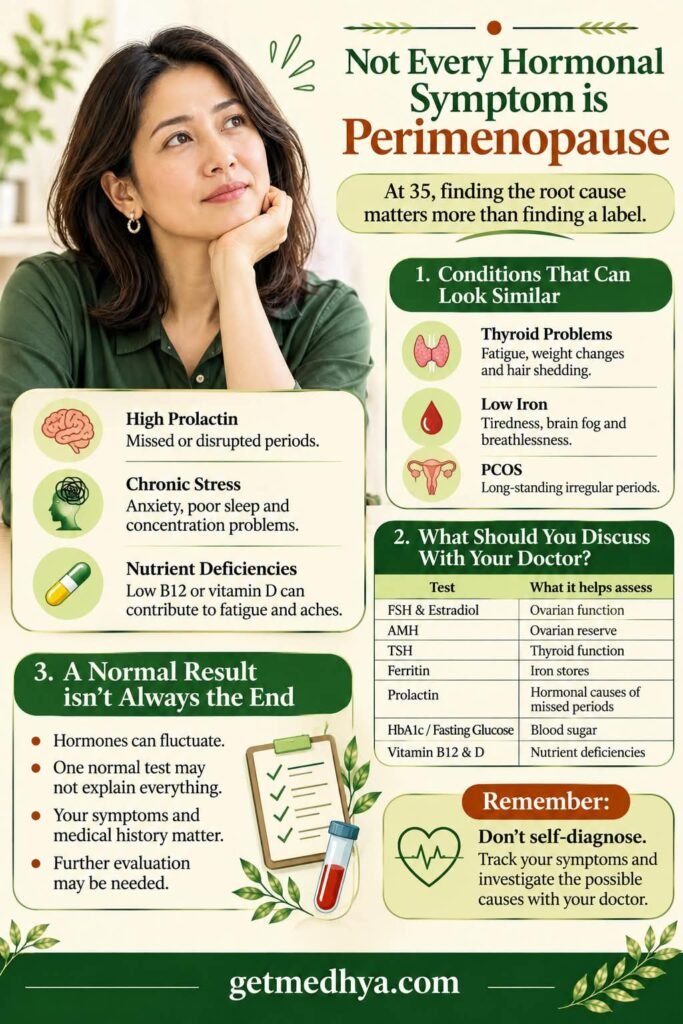
Step 1: Stabilise your blood sugar
- Build every meal around protein, fibre and healthy fat, not refined carbohydrate alone. Think moong dal chilla with vegetables, paneer or eggs with sprouts, curd with nuts and seeds.
- Eat breakfast within about 90 minutes of waking, with protein first.
- Choose slow-releasing carbohydrates: oats, millets such as ragi and jowar, brown rice, sweet potato, legumes and whole fruit rather than juice.
- Avoid long gaps between meals if you’re shaky or foggy, and don’t skip dinner entirely. A modest evening meal supports overnight glucose.
- Delay the first cup of tea or coffee until after you’ve eaten.
Step 2: Feed hormones with the right nutrients
- Fibre and gut support: vegetables, flaxseed, chia, psyllium, fruit and fermented foods like homemade curd support estrogen clearance.
- Iron: lentils, leafy greens, dates, jaggery in moderation, sesame and meat if you eat it, paired with vitamin C such as amla or lemon. Keep tea and coffee away from iron-rich meals.
- Magnesium: pumpkin seeds, almonds, leafy greens and bananas help calm the nervous system and support sleep.
- Omega-3 fats: walnuts, flax, chia and fatty fish reduce inflammation and support the brain.
- Phytoestrogen-rich foods: ground flaxseed and sesame seeds in modest amounts can gently support balance.
- Spices with a purpose: turmeric, ginger, cumin, fennel and fenugreek support digestion and calm inflammation.
Step 3: Protect your sleep
Keep a consistent bedtime and wake time. Eat dinner two to three hours before bed. Dim lights and put the screen away an hour before sleep. If you wake at 3am, a small protein-and-fat snack before bed, such as a few soaked almonds, can help steady overnight blood sugar. A warm shower, gentle stretching and a few slow breaths can signal the body that it’s safe to rest.
Step 4: Calm the nervous system daily
Schedule it like any other appointment. Five to ten minutes of slow breathing, such as extended-exhale breathing, alternate-nostril breathing or humming breath, can lower the stress response. A short guided meditation, a walk outdoors without your phone, or a few minutes of stillness each day all help. The effect comes from consistency, not intensity.
Step 5: Move in a way that builds, not drains
Strength training two to three times a week protects bone, muscle and insulin sensitivity. Add daily walking and gentle yoga or mobility work. Very long, intense cardio on a depleted body can raise cortisol and backfire, so match your workouts to your energy and sleep.
Step 6: Reduce the hormone disruptors you control
Cut back on alcohol, which fragments sleep and burdens the liver. Quit smoking if you smoke, since it is linked to earlier menopause. Limit ultra-processed foods and sugary drinks, and avoid crash dieting, which strips the nutrients your hormones need.
Step 7: Track so you can see the pattern
Note your cycle day, flow, sleep quality, mood, energy, hot flashes and any standout symptoms. After two to three cycles you’ll see patterns you can’t see from memory, and you’ll have real data to bring to your doctor.
A realistic four-week starting plan
Week 1: steady the fuel. Protein-anchored breakfast every day, no skipped meals, tea and coffee after food.
Week 2: protect sleep. Fixed bedtime, earlier and lighter dinner, screens off an hour before bed.
Week 3: calm the system. Add a daily 10-minute breathing or meditation practice and a short walk after a meal.
Week 4: build resilience. Add two strength sessions, start your cycle and symptom log, and book the tests from Part 5 if you haven’t already.
Many women notice steadier energy and fewer afternoon crashes within one to two weeks, and calmer nights and mood over six to eight weeks. Some weeks will still be harder because hormones fluctuate, and that doesn’t mean the plan has failed.
Common Mistakes When Early Perimenopause Signs Appear at 35
Dismissing it because of your age. Age alone shouldn’t be the reason your symptoms are ignored, by you or by anyone else.
Self-diagnosing from a checklist alone. A symptom list is a starting point. At 35, ruling out thyroid, iron and other causes matters just as much.
Cutting carbohydrates drastically. Your brain runs on glucose. The goal is steady carbohydrates, not none.
Pushing through with more caffeine and willpower. This adds to the stress response and often deepens the crash.
Taking random supplements. Without knowing what’s actually low, supplements are guesswork. Test first where you can.
Assuming you can’t get pregnant. Early perimenopause does not mean infertility, so use contraception if you aren’t trying to conceive.
Waiting until it gets unbearable. The earlier you support your body, the more runway you have.
Troubleshooting: When Your Situation Doesn’t Fit Neatly
“My periods are regular, but I have many of these signs.” This is common. Progesterone can start dipping before your cycle length changes. Track the cluster, rule out other causes, and don’t let “but my cycle is normal” dismiss the rest.
“My doctor said my hormones are normal.” A single result can’t capture a fluctuating system. Return with your tracking log and ask about repeat testing and a broader look at thyroid, iron and blood sugar.
“Can early perimenopause be reversed?” The ovarian ageing process itself can’t be reversed. But many of the symptoms, especially those driven by blood sugar, stress, sleep and nutrient gaps, respond very well to support. Some women with a different underlying cause, such as thyroid disease or low iron, improve substantially once it is treated.
“Is it hereditary?” Family history raises the likelihood, but it doesn’t decide your outcome. It’s a reason to pay attention early, not a reason to worry.
“I’m on hormonal birth control, so how would I know?” Contraceptive hormones can mask cycle changes. Symptoms like sleep disruption, mood shifts and brain fog become your main clues. Talk to your doctor about what is appropriate for you.
“I feel too young for this, and no one takes me seriously.” You’re not imagining it, and you deserve to be taken seriously. Bring data, ask specific questions, and, if needed, seek a second opinion from a doctor with menopause or reproductive endocrine expertise.
Where to Go From Here
So, can perimenopause start at 35? Yes, though it’s uncommon, and whether or not it turns out to be the cause, the signs you’re noticing are real information. Your sleep, mood, cycle, and energy are telling you that something in the system needs support, and you now know how to read that signal: track your pattern, test the right things, and work on the root causes, which are blood sugar, stress, sleep, nutrients, and gut health, rather than pushing through. If you want help turning scattered symptoms into a clear picture, the Medhya app’s Health Score maps your sleep, energy, cycle and stress together and builds personalised meal, movement and breathwork guidance that adapts to where you are, and if you’d like one-on-one guidance built around your labs and your pattern, you can book a consultation with a Medhya practitioner here.
This guide is for educational purposes and reflects general wellness information drawn from published clinical guidance on perimenopause, early menopause and premature ovarian insufficiency. It is not a substitute for personalised medical advice, diagnosis or treatment. If you’re under 40 and experiencing missed periods, hot flashes or night sweats, please speak with your healthcare provider.

