

Two weeks ago, you started taking magnesium before bed. The first few nights, something genuinely shifted. You fell asleep faster than you had in months. When you woke at 3 AM — because you still woke, but it felt different — you drifted back down in twenty minutes instead of lying there running through your entire day, your entire week, your entire life. You told a friend about it. You almost felt smug.
Then last Tuesday you were wide awake at 3:07am, heart doing that low, alert thud, mind already three worries deep, exactly the way you used to before any of this started. Same supplement. Same dose. Same dark, quiet room, same weighted blanket, same everything. Completely different night.
If you’re currently somewhere in that loop — the magnesium that worked, then didn’t, then sort of worked again, then quietly stopped mattering at all — I want to walk you through what’s actually going on, because it isn’t that you did it wrong, and it isn’t that magnesium was a waste of money. It’s that magnesium was only ever holding down one piece of a much longer chain. On the nights that chain is fully intact, one piece is enough. On the nights it isn’t, one piece can’t hold the whole thing up by itself.
This is the part almost nobody explains clearly: 3am waking in perimenopause is rarely a single-cause problem, which is exactly why single-cause fixes work sometimes and not others. It’s not random. It’s not “just stress.” And it is absolutely not a sign you’re doing this wrong. Once you can see the full chain — not just the magnesium piece — the inconsistency stops feeling like a mystery and starts feeling like something you can actually work with.
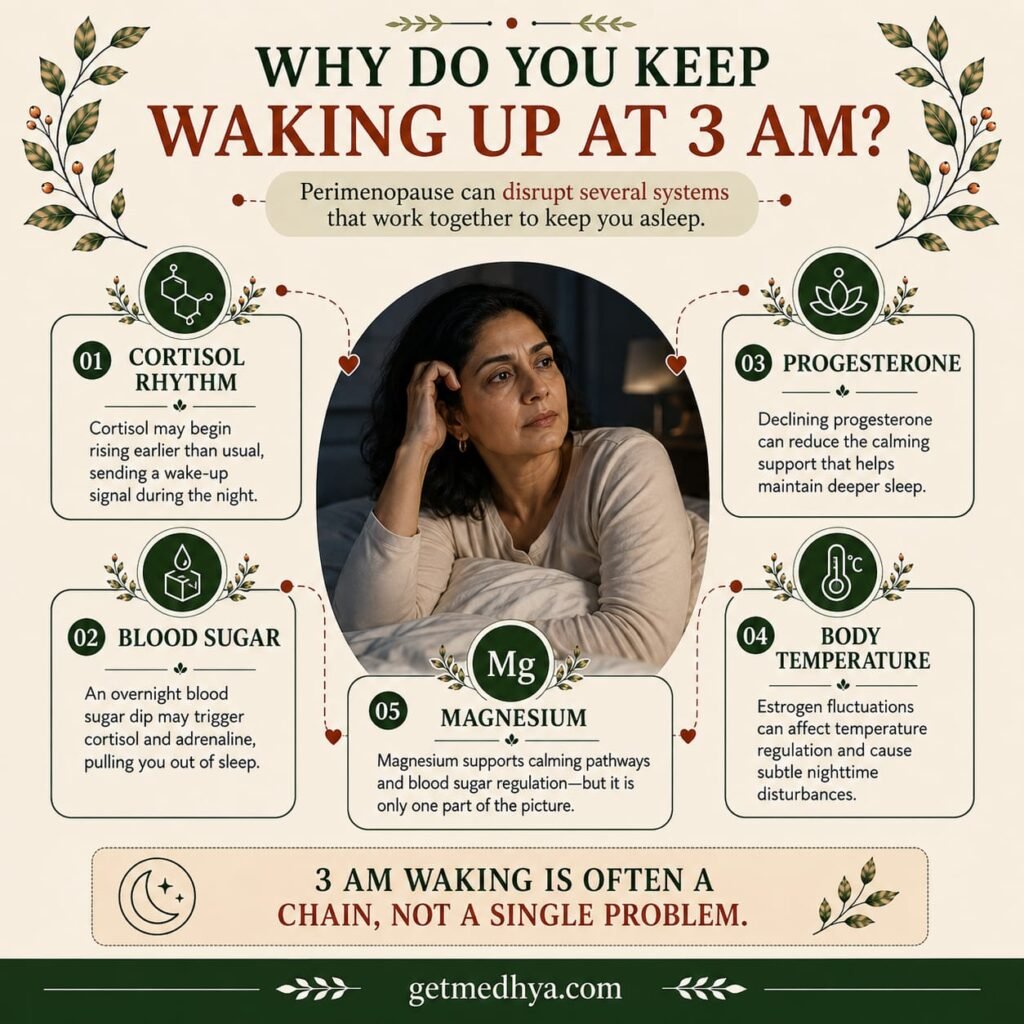
What’s Actually Happening at 3 AM
Here’s the piece worth understanding first, because it reframes everything else: that wake-up isn’t a sleep problem. It’s a signal. Your body is doing something specific and physiological in that window, and magnesium touches part of it — but only part.
Your cortisol rhythm has quietly shifted
Cortisol isn’t just “the stress hormone.” It runs on its own daily rhythm, and under normal circumstances it should sit at its lowest point in the deep hours of the night, then begin climbing gently around dawn to help you wake up. In perimenopause, that rhythm gets pulled out of shape. For a lot of women, cortisol starts rising hours earlier than it should — closer to 3am than 6am — which means your body is essentially starting its “wake up” signal in the middle of your deepest sleep window instead of at the end of it.
Your blood sugar is part of the story too
Layer onto that a second mechanism: if your blood sugar drops overnight, your body treats it as an emergency and releases cortisol and adrenaline to bring glucose back up fast. This is supposed to be a quiet, background process that doesn’t wake you. But it becomes a much louder alarm when your baseline cortisol regulation is already unsteady — which, in perimenopause, it often is. So a dinner that’s light on protein, or a long gap between dinner and morning, can be enough to trigger a blood sugar dip that your body answers with a cortisol spike sharp enough to pull you straight out of deep sleep, heart already going before your mind has caught up.
Your natural sedative is running low
This is the piece that explains why this hits so differently now than it would have five years ago: progesterone, the hormone that’s very often the first to start declining in perimenopause, breaks down in your body into a compound called allopregnanolone — a natural sedative that acts directly on the same calming receptors targeted by prescription sleep medication. For most of your adult life, that compound has been quietly doing a job you never had to think about: keeping your nervous system settled enough to stay asleep through small overnight disruptions instead of being jolted fully awake by them. As progesterone drops, that cushion thins out. The same blood sugar dip or cortisol blip that used to pass you by without registering can now yank you all the way to full alertness.
Your sleep itself is architecturally lighter now
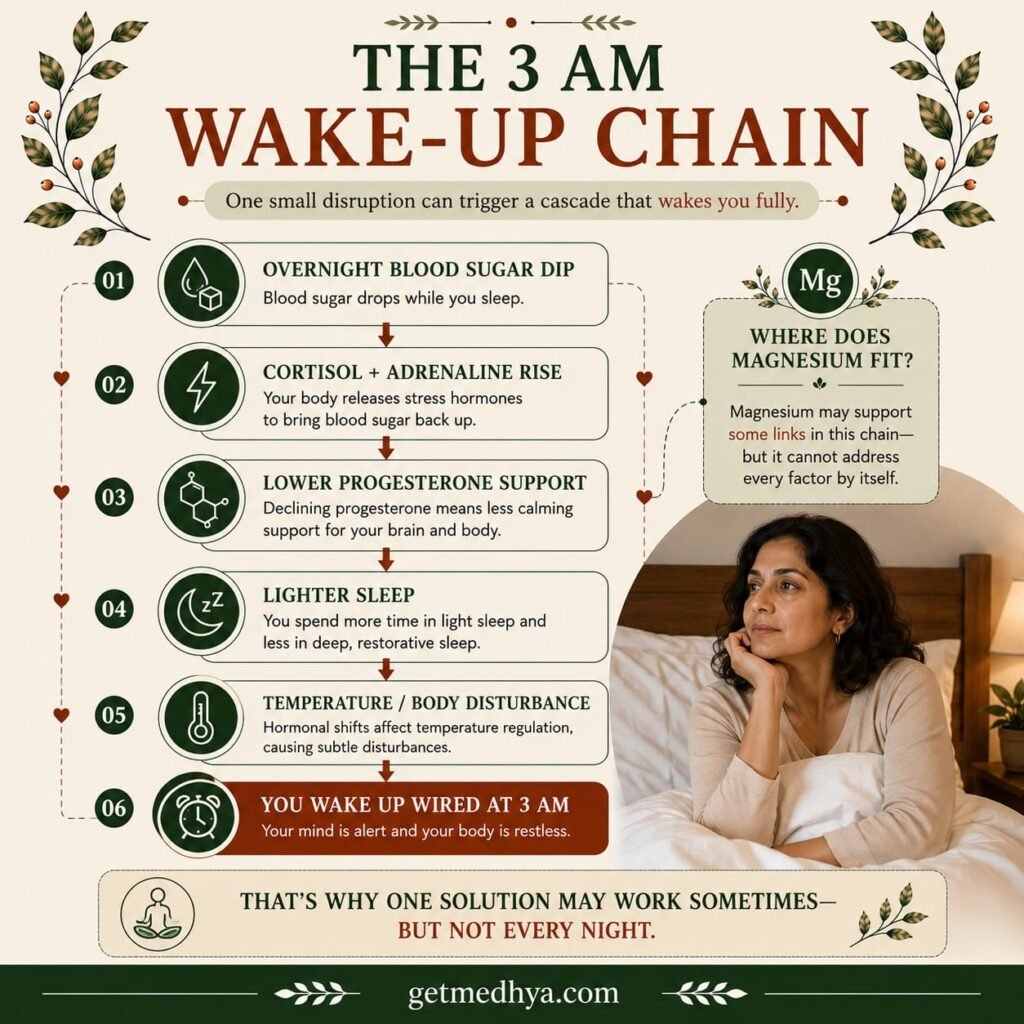
This is worth sitting with, because it explains why the same disruption that used to pass you by now wakes you outright. Progesterone doesn’t just help you feel calm — it directly increases slow-wave sleep, the deep, restorative stage where your brain is hardest to rouse. In sleep-lab studies, progesterone has been shown to cut time spent awake after initially falling asleep by roughly half, and to meaningfully increase the amount of deep sleep you get, compared to a placebo. As progesterone declines and fluctuates through perimenopause, you spend less of the night in that deep stage and more of it in lighter sleep — which means your arousal threshold, the amount of disruption it takes to wake you, drops. A blood sugar dip or cortisol blip that would have stayed a subclinical blip five years ago now has an easier path straight through to full wakefulness, simply because there’s less deep sleep standing between it and you.
Your internal thermostat is less precise
There’s one more piece, and it matters even if you don’t think of yourself as someone who gets “real” hot flashes. The hypothalamus — the part of your brain that keeps your core body temperature steady — relies on stable estrogen to do that job accurately. As estrogen swings unpredictably through perimenopause, the hypothalamus can misread your temperature and trigger a rapid cooling response: a small heat surge, a flush of sweat, a spike in heart rate, sometimes so mild you don’t consciously register it as a hot flash at all. But it’s often more than enough to pull you out of deep sleep for a few seconds to a few minutes — and when that keeps happening across the night, even without you remembering most of it, it fragments your sleep architecture the same way a more obvious night sweat would.
And here’s where the piece you’ve already been trying comes back into the picture: estrogen helps your body retain and use magnesium properly. As estrogen swings unpredictably through perimenopause, your magnesium needs actually go up, right as your body’s ability to hold onto it goes down. Magnesium genuinely does support the same calming pathway progesterone works through — it helps activate GABA, your brain’s primary calming neurotransmitter, and plays a real role in stabilizing blood sugar overnight. That’s exactly why it can work, some nights, quite noticeably. But it’s supporting one node in a chain that also depends on your cortisol rhythm, your progesterone-derived sedative, your dinner’s protein content, and your blood sugar stability — and on the nights those other pieces are more disrupted than usual, magnesium alone doesn’t have enough leverage to hold the whole chain together by itself.
This is the actual chain: blood sugar drops overnight → cortisol releases to correct it → progesterone is too low to buffer the response, and too low to keep you in deep sleep in the first place → a minor temperature blip or blood sugar dip that used to stay silent now has a clear path through → you lie there, wired, at 3am. Magnesium can soften two or three links in that chain. It was never going to be able to hold all five on its own, every single night, which is exactly why it can feel maddeningly inconsistent instead of reliably broken.
Your gut is quietly part of this too
Here’s a piece that surprises most women: roughly 90% of your body’s serotonin — the raw material your brain uses to make melatonin, your sleep hormone — is produced in your gut, not your brain. When the gut lining is inflamed or your gut bacteria are out of balance, which fluctuating estrogen can directly influence during perimenopause, that serotonin-to-melatonin pipeline gets less efficient right as you need it most. This is part of why the food changes further down aren’t generic wellness advice — a gut that’s better supported is quite literally manufacturing more of the raw material your brain needs to keep you asleep through the night.
There’s an old idea in Ayurveda that mapped this window with striking precision long before anyone had measured a cortisol curve: the hours from roughly 2am to 6am are governed by Vata, the body’s air and movement element — light, quick, dry, prone to restlessness. It’s described as the time when sleep is naturally thinnest, when the mind is most easily stirred. What modern endocrinology now adds is the mechanism underneath that observation: this is precisely the window where cortisol begins its rise and progesterone’s calming effect is weakest. Two systems of understanding, thousands of years apart, converging on the same three-to-four-hour stretch of the night.
Does this sound like what’s happening to you?
- You wake at a strikingly consistent time — often within the same 20–30 minute window most nights
- You fall asleep easily but can’t stay asleep past the middle of the night
- The wake-up comes with a racing or pounding heart, even without an anxious thought attached to it yet
- Something that helped for a while — magnesium, melatonin, a supplement, a routine — has become less reliable or stopped working
- It tracks loosely with what or when you ate dinner, how stressful the day was, or where you are in your cycle
- You feel wired, not sleepy, once you’re awake — like your body flipped a switch rather than gently surfacing
If most of that landed, take it as useful information rather than bad news. You’ve correctly identified a real pattern with a real, named cause — and every piece driving it responds to support.
This is exactly what Medhya is built to figure out with you — you answer a few specific questions about your sleep, your cycle, and your day, and it builds you a personalised plan around which link in this chain is your actual bottleneck right now, so you’re not guessing which piece to work on.
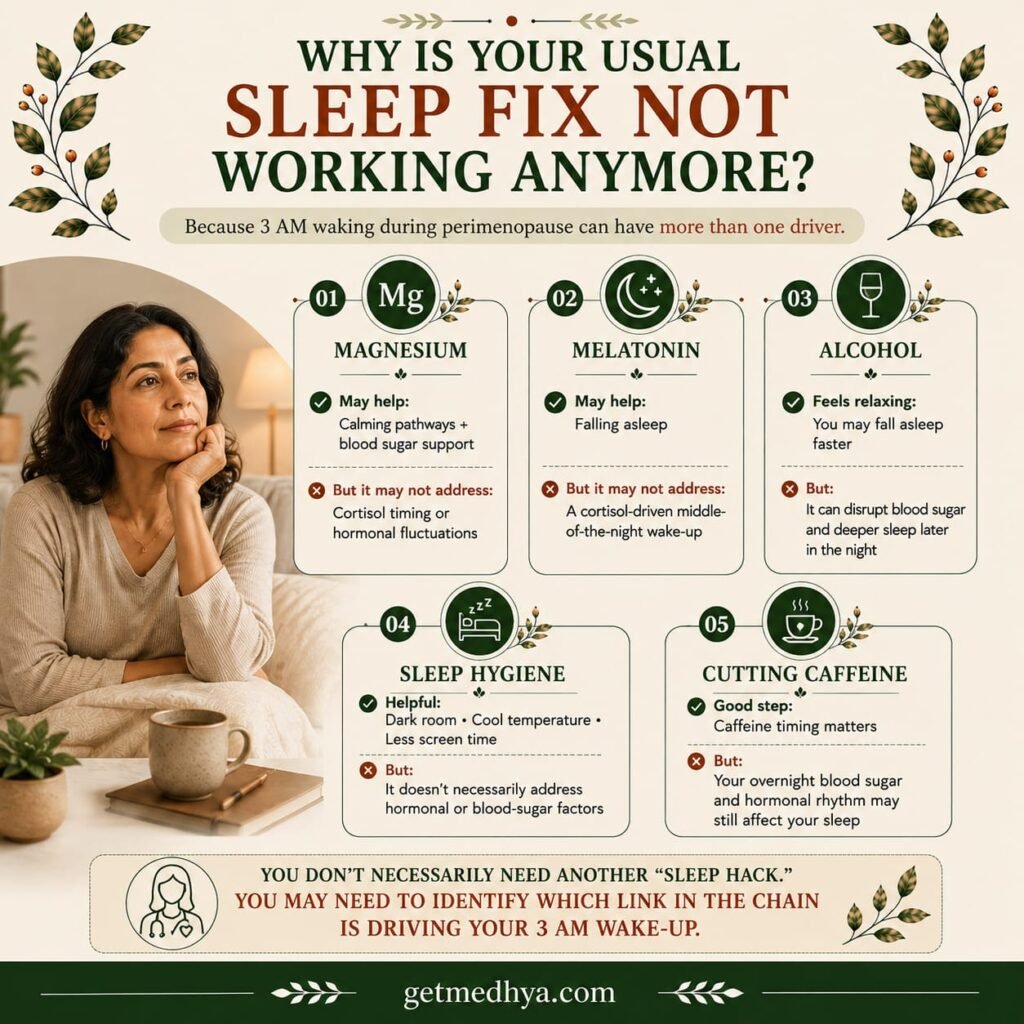
Why What You’ve Tried Hasn’t Fully Worked
Magnesium on its own. You weren’t wrong to reach for this — it’s genuinely one of the more evidence-backed pieces here, and on plenty of nights it does its job well. But it’s supporting your GABA pathway and your blood sugar stability, two links in a four-link chain. On nights your cortisol rhythm is more disrupted or your progesterone is lower than usual, magnesium can’t compensate for links it was never touching in the first place.
A glass of wine to switch off. It feels like relief, and briefly it is. But alcohol destabilizes blood sugar overnight and disrupts the deeper stages of sleep where progesterone and cortisol are meant to do their quiet regulatory work — which means it often hands you back a harder wake-up a few hours later than the calm evening it gave you.
Cutting caffeine after noon, and stopping there. Smart instinct, incomplete fix. Caffeine timing matters, but if dinner is light on protein or eaten early with a long stretch until morning, blood sugar can still drop overnight regardless of what your last cup of coffee looked like.
“Good sleep hygiene” — dark room, no screens, cool temperature. All genuinely worth having. None of them touch cortisol rhythm, progesterone decline, or overnight blood sugar, which is why you can do everything right on the environment side and still wake up at 3am on the dot.
Melatonin supplements. These make logical sense on paper — low sleep hormone, take the sleep hormone. But melatonin mainly helps you fall asleep faster; it does very little for the cortisol-driven wake-up in the middle of the night, which is a completely different mechanism firing at a completely different hour.
Just pushing through and hoping it resolves on its own. Completely understandable when you’re exhausted and don’t have the bandwidth to think about one more thing. But this isn’t a phase that quietly self-corrects — the chain that’s driving it responds specifically to support, not to waiting it out.
What Actually Works: A Real Plan
Start with Week 1. It’s the highest-leverage place to begin, and most of it happens at dinner — something you’re already doing anyway, just adjusted.
Week 1: Stabilize the blood sugar link
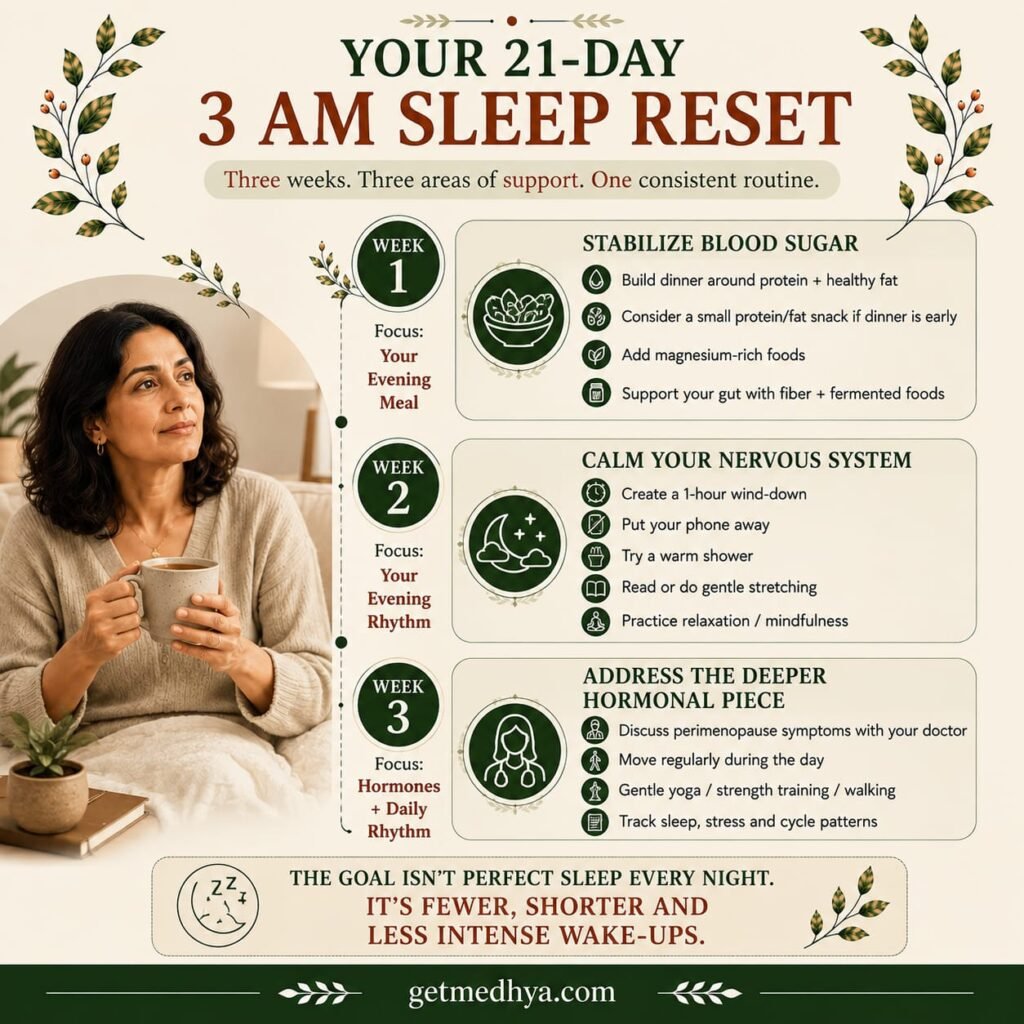
Rebuild your dinner around protein and fat, not carbohydrate. Aim for a palm-sized portion of protein — eggs, fish, chicken, legumes, tofu — plus a source of healthy fat, at your evening meal, rather than a dinner built mainly around pasta, rice, or bread.
Why this works: protein and fat digest slowly and support steadier liver glycogen stores overnight, which reduces the odds of the blood sugar dip that triggers a cortisol spike at 3am.
If dinner is early, add a small protein-and-fat snack before bed. A boiled egg, a spoonful of nut butter, a few nuts and seeds — something small, an hour or so before sleep, especially if more than four hours will pass between dinner and bedtime.
Why this works: it closes the overnight gap your liver would otherwise have to cover alone, directly reducing the trigger for the cortisol-driven wake-up.
Bring in magnesium-rich food, not just a supplement. Leafy greens, pumpkin seeds, almonds, black beans, dark chocolate. Food-based magnesium works alongside whatever you’re already taking, rather than asking one pill to do all the work.
Feed your gut alongside your blood sugar. Fermented foods — yogurt, kefir, sauerkraut, kimchi — plus plenty of fiber from vegetables and legumes, support the gut environment your serotonin-to-melatonin pipeline depends on. This isn’t a separate step from the dinner changes above; it’s the same meal, built slightly differently.
Why this works: a better-supported gut means more of the raw material your brain needs to keep producing melatonin through the second half of the night, not just enough to fall asleep at the start of it.
What you’ll notice by day 7: Some nights already feel steadier — falling back asleep faster even on nights you do wake. This week is about giving your blood sugar a floor. The cortisol and progesterone pieces are still coming; don’t expect every night to be resolved yet.
Week 2: Support the calming chain directly
Build a wind-down window that starts an hour before bed, at the same time each night. Dim the lights, put the phone away, do something warm and repetitive — reading, a warm shower, gentle stretching.
Why this works: consistency and warmth are the two things that settle Vata-type restlessness, and rhythm is also what helps recalibrate a cortisol curve that’s drifted out of its normal timing.
Try a warm, spiced drink before bed instead of screen time. Warm milk (dairy or a plant alternative) with a pinch of nutmeg has a long tradition as a bedtime calming ritual, and nutmeg in particular has a mild sedative reputation in Ayurvedic practice.
Consider a short self-massage with warm sesame or almond oil before your shower. Known in Ayurveda as abhyanga, it’s traditionally used to calm an overactive Vata state — the same restlessness that governs the 2am–6am window your wake-ups fall inside.
What you’ll notice by day 14: The wake-ups that still happen tend to come with less of a jolt — heart racing less hard, mind less immediately spiraling. This is your nervous system’s baseline settling, even before every night is fully quiet.
Week 3: Address the deeper hormonal piece
Talk to your doctor specifically about where you are in perimenopause. Ask directly how your progesterone and cortisol patterns might be playing into the timing of your wake-ups, not just “I’m not sleeping well.” Naming the hormonal piece changes the conversation.
Under guidance from a healthcare practitioner, some women find targeted botanical support helpful alongside the food and rhythm changes above. Medhya Herbals’ Ayurvedic practitioners can offer personalized recommendations here rather than generic supplement advice.
Move your body earlier in the day, not right before bed. Regular movement — walking, strength training, gentle yoga — helps regulate cortisol’s daily rhythm over time, which is the piece none of the nightly tweaks above can fully reach on their own.
What you’ll notice by day 21: For most women working through all three weeks together, the 3am wake-ups become noticeably less frequent, and when they do happen, falling back asleep takes minutes instead of hours. Some nights will still be rougher than others — that’s the honest, uneven shape of hormones recalibrating, not the plan failing.
This is where Medhya’s daily check-in earns its place — it adjusts what it recommends based on how you actually slept last night, what phase of your cycle you’re in, and how your stress has tracked that week, so what you’re doing tonight actually matches what your body needs tonight, instead of running the same static advice regardless of how you’re doing.
What Getting Better Actually Looks Like
Week 1–2: The wake-ups still happen, but they’re shorter — you’re back asleep in twenty minutes instead of ninety. Some nights are already fully quiet.
Week 3–4: The wake-ups themselves start spacing out — three nights a week instead of seven. When they do happen, the racing-heart intensity is noticeably softer.
Month 2 and beyond: Most women reach a place where 3am waking becomes occasional rather than nightly — something that shows up around a stressful week or a rough cycle phase, rather than a fixed nightly event. A few rough nights along the way, even once things have improved, is normal hormonal variability — not a sign the chain has broken again.
When It’s Still Inconsistent, Even While You’re Doing the Work
“I did the whole protocol for two weeks and I still had three rough nights.” That’s not failure — that’s hormones fluctuating unpredictably through a transition that doesn’t move in a straight line. Some nights your cortisol and progesterone are simply going to be less cooperative than others, regardless of how well you’ve supported the chain.
“Magnesium used to work every night and now it barely touches it.” That shift itself is useful information — it usually means the other links (cortisol timing, blood sugar, progesterone) have become the bigger driver for you right now, which is exactly what the food and rhythm changes above are built to address.
“I can’t tell if it’s stress waking me up or something hormonal.” Honestly, both are often true at once, and they feed each other. Tracking your wake-up time against your cycle for a few weeks tends to make the pattern clearer than any single night can.
Your 21-Day 3 AM Reset Starts Now
Week 1 stabilizes blood sugar at dinner so there’s nothing to trigger the overnight cortisol spike. Week 2 builds warmth and rhythm into your evening so your nervous system has an easier time settling back down when it does stir. Week 3 brings in the deeper hormonal piece — cortisol rhythm and progesterone — with real support, not guesswork.
By day 21, most women aren’t waking every night anymore — and on the nights they do, falling back asleep takes minutes, not hours.
The easiest way to do this? Let Medhya guide you through it. The app’s daily check-in adapts your food, rhythm, and stress-support recommendations to how you actually slept and where you are in your cycle, so the plan changes with you instead of asking you to follow the same static advice every night regardless of what your body’s doing.
Answer a few questions about you and build your personalised plan, or start your 7-day free trial and see exactly which link in your chain — blood sugar, cortisol, or progesterone — is driving your 3am wake-ups.
Want to talk it through with someone who understands the hormonal piece directly? Book a one-on-one conversation with a Medhya Herbals Ayurvedic practitioner here.
Magnesium wasn’t wrong. It just wasn’t the whole chain. Now you know the rest of it — and that’s the part that finally makes 3am make sense.
This is general wellness information, not medical advice. If sleep disruption is severe, persistent, or affecting your daily functioning, please speak with a doctor directly.